• There is no place like home, but Betty found a second home with two people who were willing to share their lives and work with her.

    Sr. Freda, a courageous woman who developed a free hospital near Kitale because she couldn't bear seeing people crawl on their hands and knees to some distant clinic and Emmanuel, a Maasai man who had to sell his two bottom teeth for a cow to put him through high school. He returned to his village and built a school for orphaned and special needs children in the mountainous region of Kilgoris. This is their story and the story of the children they are helping.

Betty’s Journal: Day Seven

The center of Kitale is like being in a traffic jam, although there are no cars and nothing is stalled, everything is fluid, everyone is in motion – people, cows, sheep, cops, street vendors holding up pink beads, cords, radio’s, scarves, key rings, old candy, mirrors.  Motorbikes and Manitoo’s stop on a dime, offering no signal, just picking up a passenger where ever they are standing as long as they can cram one more person in the already crowded bus.  The Manatoo’s speed seems amazing given that they look as if they are so full of passengers, luggage, boxes, tied to the top that they may tip over at any moment, yet they cross four corner intersections without traffic signs or stop-lights and I stare in awe, wondering if I’ll ever be able to cross the road and what are they trying to construct by dumping a pile of dirt in the middle of a dirt path or if the boy trying to cross the intersection will stay alive.OLYMPUS DIGITAL CAMERA
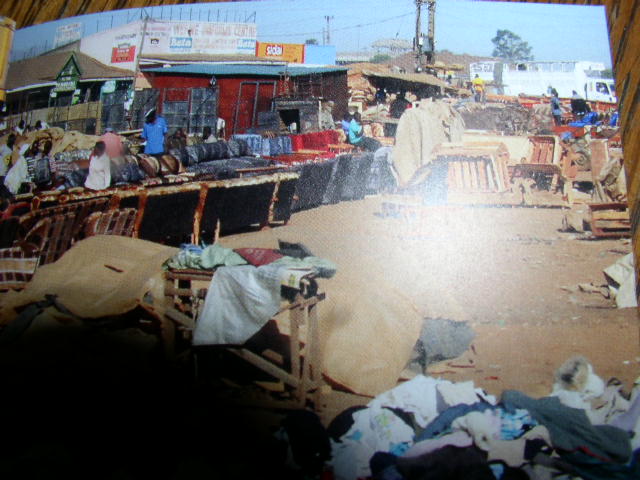
This is the contemporary, complicated area of Kitale, a small village with the hustle of a big city, it’s go-go atmosphere doesn’t have the poshness of a New York, but it out does New York by its mix of wild-life searching for street space and its never ending winding streets that are more like dirt paths.  They stretch out like a river breaking free of its determined course and run every which way, without street signs to guide you.  My heart speeds up at the thought I will never be able to retrace my steps and get back home, for my little cottage feels like home to me now.  I put an African violet on the small table I use as a desk and tie the curtains back with some shipping plastic someone had left.

I walk past a museum that has a statue outside and decide to go in.  The fee is $10,000 shillings ($10.00) for non-residents and for that money I’m given a guide who is telling me of the early life of villagers and it looks to me that the stuff in the museum still represents the life of the village today.  It doesn’t appear to be something that happened long ago and doesn’t happen anymore.  People in the countryside still live in the same mud huts with monkey’s screeching in the trees and children running barefoot in the heat of an afternoon and men with many wives and women doing most of the work and sons treated as kings and many daughters continue to be circumcised.

I’m intrigued by a sculpture garden, statues of Jesus and Moses on the mountain top.  A nature walk through a forest is alive with monkeys, both black and white hiding in trees.  We cross a wooden bridge made out of tree branches, and the swamp water is golden, reflecting the mossy tangle of roots, spreading out like ancient ruins.  The air is filled with smoke from women cooking over their wood fires.  After crossing another bridge, we are out of the forest and came to an open field of mud and grasses.  My guide tells me it is a sanctuary for all animals that were born deformed and would have died or have been killed because they were of no use to anyone.  With pride, he points to a one legged goat, a four eyes cow, two lambs attached to one another.  He carefully points to each deformity and tells about it as if it was a prized gift from God, not something to pity and I think the animals are luckier than many people.
Betty’s Journal: Day Six

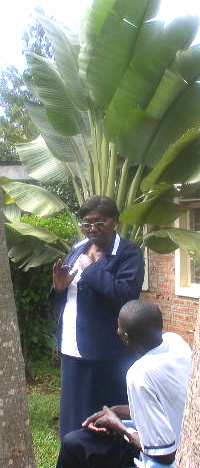
I’m still in my own story, dragging it around with me like a heavy chain, thinking it defines me.  It is only when I let go, like a leaf leaving a tree, that I escape and experience myself in the present.  I think of this as I visit Sr. Freda’s hospital today. There is something mysterious about healing.  I think it requires letting go and accepting the present pain, struggle, hope and change.

OLYMPUS DIGITAL CAMERAThe “Fire” trees are in bloom and the hospital compound stands out, an island of scarlet in the grey surrounding bush.  The front of the hospital is smothered with flowers and there are a number of benches.  Two old men sit in the shade of a mango tree, their  heavy eyes watching whatever life that might be likely to pass.  They seem older than they are in their tattered gowns.  Men often sit here as they wait for specific times of year, for when there is no rain, there is little for them to do.

As I step inside, I immediately feel the hospitals crispness and yet it did not feel like a scary place.   Of course, it has, like most hospitals, that sterile, bleachy smell, but it also is the coziest hospital I have ever been in.  The walls are white and the floors tiled, but every now and then, like the sun restoring warmth and color, you come upon a wall painted with  a tree or an animal.   In the pediatric ward, a room with four beds, the walls each have a painted animal, a giraffe, an elephant, a puppy and a monkey.  Sr. Freda believes the painted walls  help bring comfort to children and soothe their fears, which goes a long way towards helping a young child heal.

She invites me to come with her to the maternity ward where a young woman has given birth to twins.  Her mother and father sit on the bed across from her, holding one of the twins, while she is trying to get the other infant to nurse.  She is a very young woman, with her hair a bundle of braids.   Her infant is clasped close to her breast.  Sr. Freda leans over and gives the baby a loving pat and talks to the mother softly in Swahili.

 The woman looks at me shyly, and Sr. Freda introduces me.  It is a pleasant moment, and everyone is excited by the twin births.  But after we leave, Sr. Freda explains to me that the one baby, the smaller one isn’t nursing. She won’t take to the nipple.

 I remember the many nights I woke to a crying child and how at first my daughter, who had been in the hospital for surgery the day after she was born, had a hard time nursing.  I would put a bit of honey on my nipple to entice her and after a few times, she began to happily suck away.   I offered this suggestion to Sr. Freda.

That night as we sat at dinner I could see that Sr Freda is clearly exhausted tonight.  I watch her as she sprinkles some water over her face.  It glitters as it trickles over her violet skin.   I suddenly feel alone, like I was pushed back from her as she thought about the details of her day.  It was as though she had formed a kind of shell around herself so that she might pray for that small child.   Outside, clouds of dust swirled through the compound as a wind picked up.  I could hear Kucca in the kitchen and the sound of a pestle and mortar, each beat resonating with my heart.

Sr Freda momentarily left the room and when she re-entered, she had a big smile on her face.   “I had a call from the hospital.  The baby has begun to nurse.”  She gave me a hug and joked, “Clearly, a little honey and prayer goes a long way.”

Tonight, as I lie in bed, I think of motherhood and how we all have secrets to share about taking care of babies and wish their was a book of Mother’s Wisdom.  I remember being terrified as a young mother and turned to Dr Spock’s book, Baby and Childcare.  He encouraged mothers to trust what they knew, but still I found he  ran a tight ship when it came to scheduling feeding and sleep.  Many nights would find me frantically reading while my daughter frantically cried.  I’d read and read and read and my daughter would rebel, rebel, rebel.  We both tired ourselves out with  nights of crying until I began to catch on to what my daughter was trying to tell me and eventually found the courage to trust my own instincts.  I didn’t throw away Dr. Spocks book, but rather adapted things to what I found true for me and my first born.  She started me on the path of listening.

It is like that here.  Sister Freda listens with her heart,  trusts her instincts and adapts her years of medical training with her own wisdom.   So much compassion can be expressed by a simple room with a cheerful  painting, painted by a local artist right on the wall, unframed by notions of what a hospital should look like.

Betty’s Journal: Day Five

Every morning I wake to the howling and screeching of monkeys and barking of dogs.  The monkeys sound like hundreds of old, rusty iron gates opening.  Everywhere I look there is deep poverty.  It is nothing like a poor neighborhood in America, for it is a poverty that stretches along the whole land.  Survival is based on living with whatever is at hand.  A piece of wood can hold a sack of grain, two or three can build a shelter, ten sticks will cook a meal.  And, unlike a poor neighborhood where I am from, here I’m surrounded by beauty:  royal blue birds, flaming red trees, a wilderness with wild animals just beyond the deeply rutted roads and corn fields.  When I was young I used to play a game with myself of trying to trick the devil.  I am now  hoping it might work if I meet up with a lion.   At night, when the dogs bark, I can’t help shivering at the thought of what might be creeping close.

Last evening, Evita, Sr. Freda’s 13 year old granddaughter took me for a walk around the village.  As the evening sun left patches of light across the valley, we walked across a potholed road to a landscape scattered with cactus.  We followed a dry river bed that ran like a gutter alongside the road, high above constant traffic.   The air felt more laden with smoke as everyone was cooking over open fires.  At one point we passed a family of baboons sitting by the side of the road grooming themselves and one another.   They ignored us as we passed by.  She took me down a tree-lined lane and we were greeted by  more than fifty monkeys jumping from trees to roofs and back to trees.  I picked up a stick and swung it as we walked to keep them from jumping on us.

A series of flimsy Kiosks lined the path.  Around them, groups of people tended to their affairs.   At the end of the lane a woman stirred a metal pot lodged in a dead tree.  Evita ran in front of me, teasing that she was going to leave and I would be lost.  “You’re lost, you’re lost,” she cried as she ran away.  And indeed I was.  I was lost and growing tired after being with the children all day, but Evita loved to run and jump and tease.  She wanted to be an engineer, but her schooling was stalled because her tuition couldn’t be paid.

I waited for her to reappear in front of a rickety stall with one kerosene lamp that seemed to oppress as the twilight deepened and the insects gathered around the lamps glow.  The feeling I knew, had something to do with feeling out of control.  A layer of dust lay over my feet.  It seemed an obsession, my need to wipe my feet.  Every night I poured a small cup of water over them if there was no water for a shower.  Perhaps Evita sensed my mood for when  she returned she spoke with kindness in her voice.  “We are almost home.  We just turn here.”


The days pass, alternating between the morning rains and sunny, white afternoon light and purple dark nights.  Each morning I’m with the little children.

Today we make a friendship chain with magazines I had found at Sr. Freda’s and cut into strips. They clamor for pieces of tape, their hands reaching out, needing the tape as much as they need milk.  Any small thing is a great thing to them.

After lunch I hurry to the girls high-school.

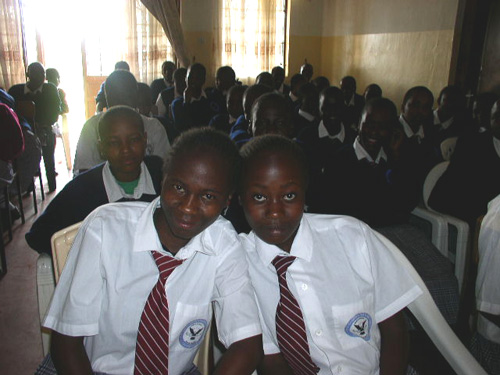
The young girls sit up straight and I am surprised by such attentiveness.   I can only wonder if they are acting or really find talking to them about writing, music, Michael Jackson and dancing interesting.  I sense a desire to learn here for they are both  grateful for the opportunity they have been given by Sr. Freda and fearful it can be snatched away.  At any minute they could be called back to a step-home or village elder to help put an older, or younger boy through school.  There is an urgency to gain as much knowledge as they can each day in order to have a chance at a future, a job, a career. image

Many of the young girls here will turn to nursing, for Sr. Freda has also created a nursing school on the compound.  She grows all the food to feed the children, has a primary program for the little ones, began the high-school for girls, and it is here, where her dream for a hospital began.  The hospital is a place where the poorest of villagers can come and receive care.  She is truly a miracle worker in the flesh.  Her life is devoted to her people and their plight.  She has raised up a hospital, fully equipped for surgeries, every day illness or injury and maternity care.  People from these remote mountainous villages no longer have to “crawl on their hands and knees” to the Kitale hospital for care.  They are admitted here without cost.  Everything she has done has been dependent on donations and, as she says, “God’s help.”

“What’s your name,” asked a girl of about fourteen who was standing on a bench outside the school.  I told her.  “Are you from North America?”  I said yes and was impressed she asked if I’m from North America rather than America.  “I’m very happy to see you,” she said and ran off to meet her friends.  They howled across the school yard, singing at the top of their voices “The American is here!”

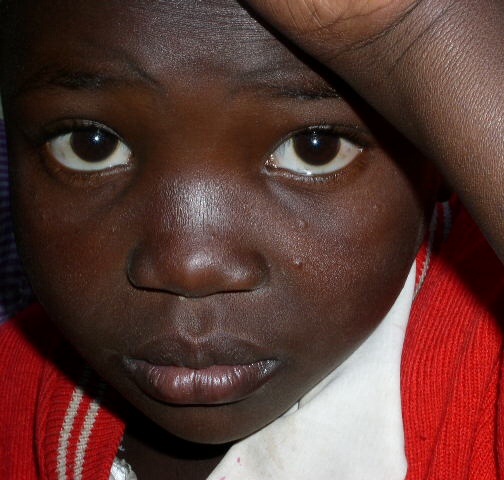
I was glad they were in school.  Many of the girls here begin taking care of their siblings at the age of seven, some even earlier.   If they hadn’t been fortunate to meet Sr. Freda, most of their day would have been spent hauling water.  It takes hours of a day to walk to fill jugs of water for a family that may have seventeen people, leaving girls unable to attend school.  Their playthings of rags, sticks, old tins and any other bits of refuse they could lay their hands on make them seem young, but when I look in the faces of some of the village girls, I see eyes that are already cloudy with despair.

OLYMPUS DIGITAL CAMERA

  • Enter your email address to follow this blog and receive notifications of new posts by email.

    Join 62 other subscribers