• There is no place like home, but Betty found a second home with two people who were willing to share their lives and work with her.

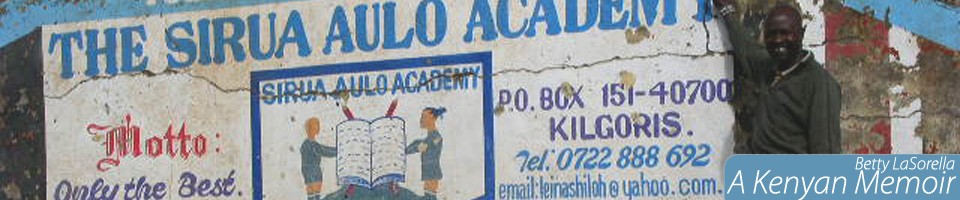
    Sr. Freda, a courageous woman who developed a free hospital near Kitale because she couldn't bear seeing people crawl on their hands and knees to some distant clinic and Emmanuel, a Maasai man who had to sell his two bottom teeth for a cow to put him through high school. He returned to his village and built a school for orphaned and special needs children in the mountainous region of Kilgoris. This is their story and the story of the children they are helping.

Betty’s Journal: Day Fifteen

DAY FIFTEEN

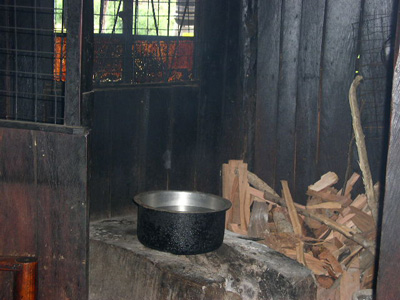
Lillian takes her shower  first.  We shower outside in a small enclosure open to the sky with a bucket of water heated over a wood fire.  It’s quite delightful looking out at the night sky as I poor water over myself.  I’m so grateful to have a bucket of water to wash with.  Not having clean water is the biggest challenge for me.  I am able to navigate the latrine, nothing but a hole in the ground, but water is the real challenge here.  Carrying it, getting it, boiling it.  Nothing but bottled water or boiling water can be used to drink or brush your teeth.  I begin to hoard it, taking just little sips, storing extra bottles in my hut.OLYMPUS DIGITAL CAMERAOLYMPUS DIGITAL CAMERA
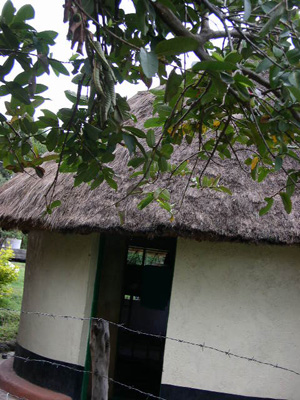
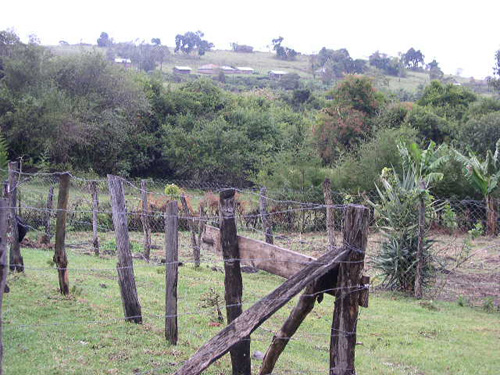
I step out of the shower and zig-zag my way back to my hut with my flashlight, trying to dodge the cows poo as they follow me.  One bull hates me and I’m afraid of it and wait until it moves away from my pathway to the hut.  There is a barb wire fence all around the hut and I lift the two boards off the post and put them back to keep the animals out, especially the cows for they will leave a big pile, and I mean big, of poo.OLYMPUS DIGITAL CAMERA
The next few days are a big surprise for I am being whisked off to a Safari with Emanuel, his wife Lilly, their son Larousi and their two good friends, Linda and Dan.  It was to Linda and Dan that I owe this wonderful adventure for it was Emanuel’s wedding gift to them and I was along for the ride.  The right place at the right time thing I always heard about and now it was real for me!

Linda and Dan had generously raised money for the school by asking people not to give  gifts for their wedding, but to donate the money for Emanuel’s school instead.  They raised $10,000 from the generous gifts of their friends and family and it was used build a room for special needs kids.

We leave early in the morning, too early for me to do anything but stare off into the wall of tall grass and the sun suspended in the sky, staring at us with white unconcern.  We are headed for the Maasai Mara about four hours from here.  It is the Serengeti of open plains, grasslands and thrilling wild-life.  As I stare at the dirt road stretching before us like an ocean whose waves have magically petrified, I listen to Emmanuel tell us about the Mara.  “The name comes form the Maasai word Maa, which means spotted and that is what comes to mind when you spot a lion, or gazell, or the great umbrella trees and drifting clouds that map the sky and throwing the only shadows across the desert like area. ”  You can hear the love in his voice for this place where he grew up and came back to in his adult years.  Lillian, his wife is quiet as he talks.  She was the last one to get in the car this morning.  Emmanuel whispered to me that everyday he gathers his son into the car and waits, thinking for sure this is the day she will be ready when she says she will be,  but every day he is disappointed.  He doesn’t sound disappointed, but sounds rather amused.

The Serengeti was also named by the Maasai from the word siringt which means “the place where land never ends.”

When I first spot the endless, almost treeless grassland where the wildebeest breed, as they remain in the plains from December to May, it is more than what I could have imagine.  It’s like seeing the Grand Canyon for the first time.  I feel light headed, but it is not just from excitement.  I’m getting sick.  One of my fears before I left was that I would become ill and not be able to take part or worse, become a burden on my hosts.  I fight back the fever I feel coming on with a fierce determination as Emmanuel points out the Mara river.  He’s an experienced guide, for after leaving college and returning to his village, he raised money to start his school by giving Safaris.  As we drive into the park, my mind plays back a  thousand images from National Geographic of wildlife roaming the vast canvas of the Serengeti.    I stare at the sky.  It  switched from the muted color of morning to the brightness of afternoon sunlight and in spite of the heat, I begin to shiver and sweat. 

STORY: THE ORGIN OF THE MAASAI

THE ORIGIN OF THE MAASAI by Kelvin Leina Biwott  (This essay has been slightly edited.)

The origin of this ancient warrior tribe is believed to have originated in North Africa and migrated South along the Nile Valley, arriving in Northern Kenya about the fifteenth century.  They conquered tribes in their path as they continued southwards and by the end of the nineteenth century they extended from Northern Kenya through the Great Rift Valley into central Tanzania.  Today Maasai land covers much smaller areas as land was taken from them by European settlers and later by African agriculturalists.

The Maasai are composed of a rather loose association of sub-tribes or sections.  Each section has its own territory, dialect and custom but all Maasai are united by a common language and clan system.  Maasai believe in a supreme God, “Engai” who lives in heaven and on earth and to whom they pray.

Traditionally, the Maasai are a cattle keeping people.  Cattle provides almost all of their daily needs; milk and blood for drinking, hides for leather and meat on ceremonial occasions.  They live a semi-nomadic life as they search for good pastures and water for their herds.  The welfare of their animals is paramount, even their settlements are built within a strong enclosure to protect their livestock from predators.  The women build low oval huts of branches and grass plastered with a thick layer of cow dung which keeps the family warm and dry.

Each Maasai male passes through three main life stages; boyhood, warrior and elder hood.  Before becoming warriors, the youths are circumscribed.  Girls too are circumcised at puberty, making them eligible for marriage.  The boys will  lead a carefree existence in a special village called “Manyatta” built for them by women relatives.  The warriors protect the herds against predators and cattle raiders.

After every ten years, a new generation of warriors come of age and passed junior elder hood in a colorful ceremony.  This marks a period of greater responsibility, beginning with marriage and security in the form of cattle and children.  Maasai elders have the right to sit in council with other elders to dispense justice and make decisions about important issues of the day.  Maasai elders may have one or several wives.  Still some Maasai cling to their traditional way of life to a great extent.

Betty’s Journal: Day Fourteen

DAY FOURTEEN

I’m in a round Maasai hut that feels claustrophobic.  I lay awake even though I’m exhausted after the long trip and meeting my new host family.  I wish I could invent a version of myself on this first night that isn’t so scared. I give myself a brief moment to wallow in doubt and self-pity.  I know the days ahead will demand a lot of me. I fear the energy I need to cope with this part of my journey will not be enough for I feel myself coming down with a bad cold.  Oh, I don’t want to be sick so far away from any comfort or ability to care for myself and I hate to be a burden on the young family who I’m going to be working with at their school.  I also hate feeling like I’m not up to this and don’t want to be seen as sickly or have anyone worry I can’t take care of myself.

Before having to get up and face how to brush my teeth, or go to the toilet, I remain in bed for a moment and think about the people I’ve met.  It would take a whole book to write about the Kenyan people, but so many have such joy in their faces when they smile and it seems they smile a great deal.  Of course there are the hustlers, trying to make money, buzzing around at markets, selling anything from opening your car door to vegetables or just holding out their hands for a few coins.  That is what poverty drives a person to. Same here as down the street from my home in America. I had expected things to be better by now in America, but everyone has become worse off than when I was young  and for a moment I think I should be back  home, doing something in the city where I live instead of this far off village in Kenya.

  • Enter your email address to follow this blog and receive notifications of new posts by email.

    Join 62 other subscribers