I’m thought of as old here. A woman said, “You are so old to have come all this way to see us.” I think of myself as aging, but not yet old. In fact, here, in this village, I feel young and new.
I have never been physically this far from my children, without any way to communicate with them. I had just turned 17 when my first child was born and I was not yet a person myself. I think each step we took, the children and myself, away from one another felt to me like an active sorrow, so deep it would take my breath away. But then, there was this freedom that broke through into a mysterious inner place, a place that had more room for me. I find it funny that when everyone is thinking I’m old, I feel so young. I’m experiencing myself in a new, totally different culture and adventure is all around me.
After breakfast, we leave for the smaller village where Sr. Freda has her school and hospital. We bump our way out of the compound and along the dirt road that twists and turns, to the main dirt road that will take us to the school. People are walking about, herding goats, carrying large bundles of sticks or sacks of grain across their shoulders, women with large jugs of water on their heads. Crowded Matatus’ fly past us and I stare at the people squeezed together along with their luggage, chickens and boxes piled on top of the bus. Motor bikes shoot in and out, their ability to navigate the roads better than cars or buses.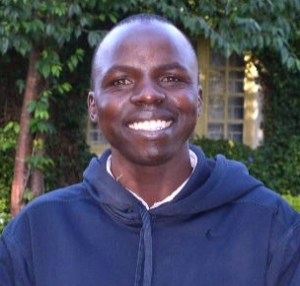 (Daniel)
No one speaks as we drive through clouds of dust and I only let out my breath after Daniel, Sr. Freda’s driver, stops suddenly to avoid hitting a herd of goats crossing the road. After we start up again I watch a man running barefoot, his high steps seem majestic as he runs alongside our van. Before we pass him, he sprints ahead. I can’t believe he is passing us, running up a steep hill. Not only him, and the motorbikes pass us, but men on bicycles pass us also. I guess cars are not the best means of transportation on these dusty, rugged roads
After driving for about 40 minutes we come to a small village, a single strip of road with a few painted wooden shops and a few raggedy vegetable stalls. Women with long knives stare at us in silence. We turn onto another dirt lane that is the entrance to the hospital and school. The bottom of the car scrapes over stones. It is a long road, with fields of maize on either side. People we pass wave at Sr. Freda, who smiles and waves back. She looks happy to be here. I think when she’s at home all she does is worry about what may or may not be happening to some of her patients at the hospital and finds it easier to be near them, on hand to oversee the details of their care.
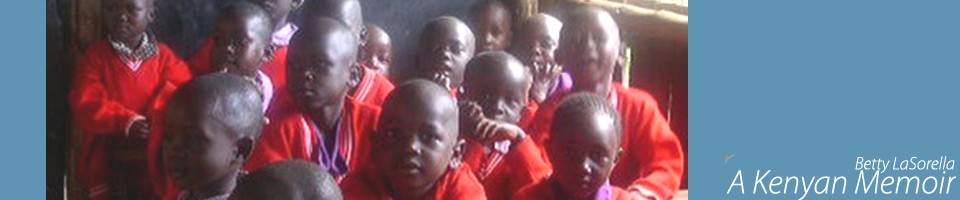
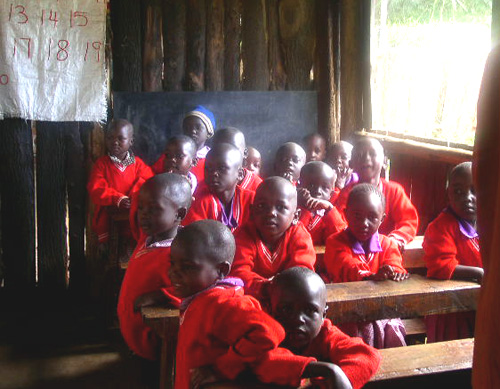
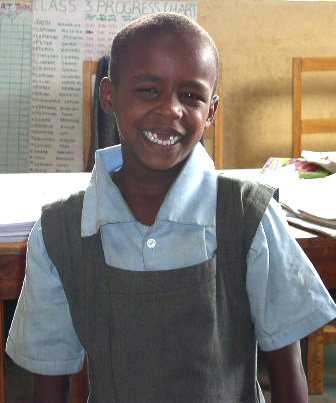
I’m taken to the primary school where I meet the children and the two teachers. The teachers seem happy to see me and let the children break from learning the English word for DOG to visit with me. 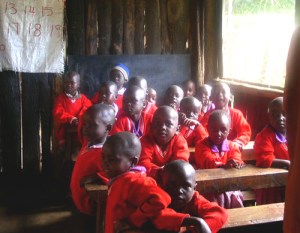
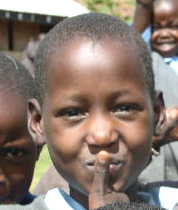
As the morning wears on, I become more and more exhausted. The children’s energy drains me now. I love to be with them, and delight in their laughter, their curiosity, their honesty, their touching, pulling, but I soon run out of things to do. I sing songs, read books and dance the hokey pokey. There is nowhere to sit, no patch of grass where a person or child could lie down to get off ones feet, not even a chair. I wanted to sit and let the children tumble around me. They love to touch and be touched. One young girl frowns as she focuses on pulling my scarf from my neck, while another concentrates on getting the rubber bracelet Sr. Freda had given me off my wrist. I want to give them everything, all of me, everything I own. They can’t seem to get enough love and attention and it reminds me of how often I’ve felt like that myself.
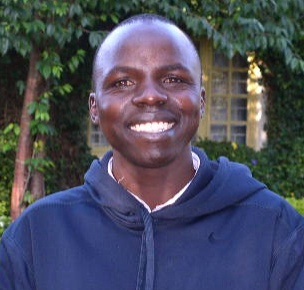
I talk with David, one of the teachers for a moment. He seems to do everything himself from buying flour for Ugali to scraping up supplies. He’s very handsome, with a kind smile, but his eyes look tired. It is a daily struggle to keep this program going. “It is important to help these children to speak up,” he said. “They are often very shy.” He seems to be shy himself, talking to me without looking at me. He speaks a bit guarded, as if he can’t really trust me. I see him glancing at me sideways, looking as if he wants to ask me something. He decides not to and I take a guess at what he might have wanted by saying, ” I would like to get something for the children before I leave. What do you need?” All his shyness disappears and he rattles off a list of books. “Science, math, readers, and spelling charts.” He specified what grade level and where they could be purchased.
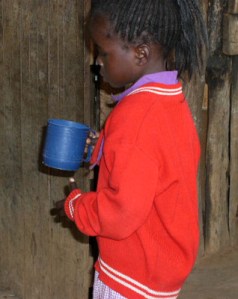
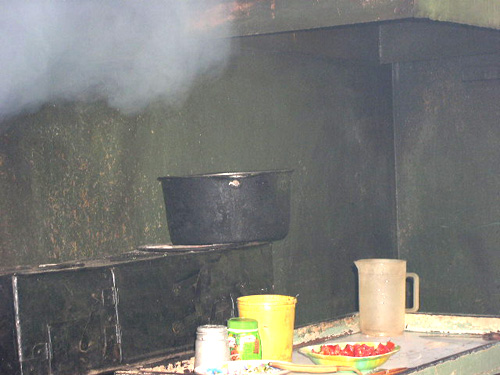
It was now time for the children to line up to get their second cup of cereal made from the common garden of the compound and cooked over a wood stove in a small shed that is the kitchen where food for the whole compound, the girls high school, the nursing school and the hospital is prepared.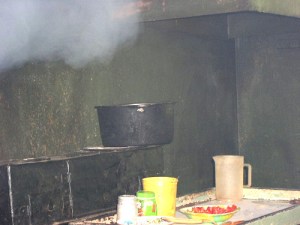
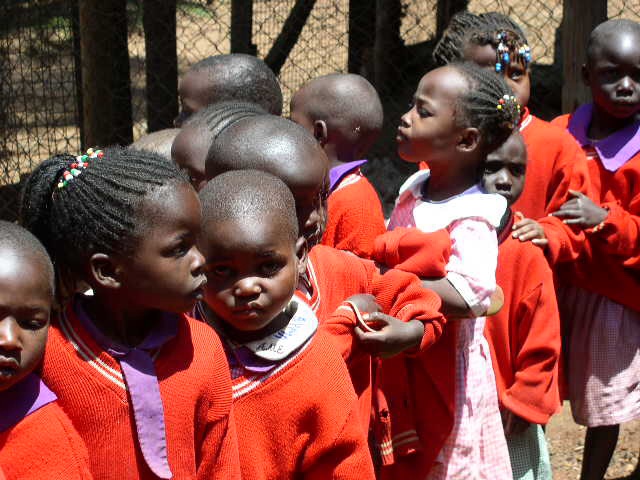
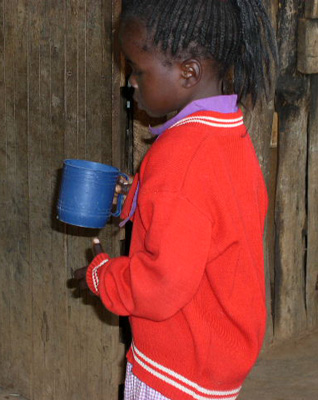
The children line up to receive a cup and they hold it out while the other teacher fills it. They don’t push or crowd one another, but wait patiently for their precious cup of cereal. This is the highlight of their day and the reason many of them, just five years old, walk five miles a day to get to the school. 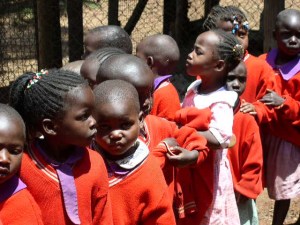 After they eat the teachers have a quick bathroom break. I ask David, when he returns if he ever takes extra classes to stay up on educational ideas. “I can’t afford to travel to Nairobi where most of the conferences are held. I learn most of what I need to learn from watching the children. They tell me what I must do.”
I find myself pulled in by his sincerity and dark, eyes, the iris so big there is very little white. Before coming to Kenya I had read horror stories about classrooms with one hundred students, sitting lifelessly, learning by rote and sometimes hit with a stick for a failing grade. This classroom, with the light and dust blowing threw the flimsy wooden slats, may not have much, but as long as there is a teacher like David, I think the children will learn.
He tells me he loves teaching, but he is also struggling to survive with a family of his own to house and educate. I understand. I’m exhausted from one afternoon with the young children. Instead of eating lunch, I take walk down a dusty lane. I turn off a back road and hop through a broken stick fence. It feels like I’m in someones back yard for there is an overturned laundry bucket and clothes hanging on a line. I come to a small shed. The doorway is draped with long yellow ribbons. I want to peek inside, but lose my nerve.
I mourn my chance to see what was behind the yellow ribbons as I sit and eat a quick lunch of cheese and a hard boiled egg. I sit still in the sun, my back to a tree. I can’t take my eyes off the thin grasses that move like paper in the wind as I think about David and his shy smile and the yellow ribbons and how mysterious something looks when you’re far away from home.


 Betty In Kenya