
My time here keeps unfolding like the slow unwrapping of a gift. Today I’m going to Mount Elgon. The elevation is about 4,000 m. It is a massive, solitary volcanic mountain on the border of eastern Uganda and Western Kenya. Katali sits at the foothills and as I look at the road we must travel, I wish I was still sitting in Kitale. We are on a mission to visit one of Sr. Freda’s friends who had lost her husband. People’s lives here are deeply connected, and even though we are miles from where this family lives, it seems that somehow Sr. Freda has learned of their sorrow.
I find myself being pulled into her life and as we drive along the dangerous mountain paths, clogged with boulders that we have to go around and holes so deep the van tips precariously to one side. I hang on to the seat in front of me to keep from sliding out the open window, thankful for Daniel, the driver, who patiently slows and brakes and speeds up. I’m in the depths of what I think of as my soul consciousness, trusting a deeper, truer part of myself to both accept my fears and enjoy the ride.
Meanwhile, as I’m bouncing and tossing around in the back seat,thinking I will never again complain of the rutted roads in Minnesota after a harsh winter, Sr. Freda happily tells me, “Oh, for the next few hours I can relax and leave all my worries behind.”
Relax, I want to ask, how can you relax while you bounce around like you’re stuck inside a clothes dryer, but she is clearly enjoying herself and points to the East, “See the tea plants? Kenya is one of the largest exporters of tea.”
I stare at the miles and miles of tea and corn that fill the mountainous region and my mind is filled with images of hundreds of people tilling the land by hand, trying to break down the red soil, rocks gripping the earth like fists, and steep banks that would wash away during a torrential rain except for the plants holding the soil down.
As we pass small villages, I am surprised by how deserted they appear, with small open markets where goods set on the ground, with small squares of cardboard or plastic for protection and only a few people sitting under “Flaming/Fire Trees” named for their bright red flowers. After traveling for about an hour, we come to a crossroad in one of the small villages where paths run to and from small compounds or areas where different tribal families live together. We stopped on a corner where three roads ran together and pick up two women who were waiting on the side of the road. One, a very small woman with smooth skin and a cloth draped over her head, reminding me of an ancient Goddess and her daughter. They smiled at me as they climbed into the van, but no one spoke. After a while, the daughter took out five bottles of coke and passed them to everyone. I still have no idea how they knew to wait for us at that time and spot that looked to me like every other place we had passed.
The road in front of us became steeper as we climb and climb and climb and after three hours, the road narrows to a small path, hemmed in by rocks, brush and small trees. We bump along, the low grinding of the gears whining like a tired child until we can travel no further with the car.
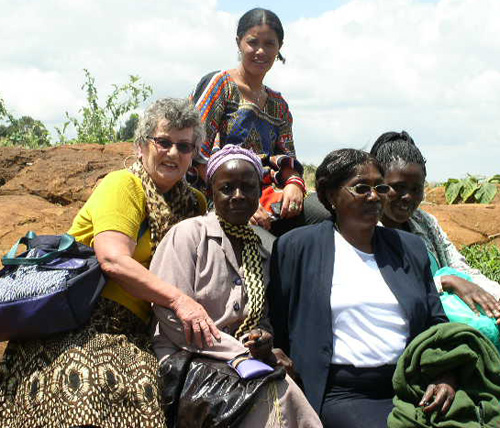 We stop and get out and take pictures by three huge boulders while Sr. Freda, happily again, for she seems invigorated by the journey, announces we will have to walk the rest of the way. And, off she goes, walking down the narrow, rocky path. She walks so smoothly, looking as if she is floating on water while I stumble and have to stop and find a tree limb to hang on to as I make my way down, my knees feeling their years. The sun is hotter here, my eyes hurt from the blazing white light and I’m glad for the scarf I wear to cover my head and shade my face.
In the intense heat it is easy to lose track of time, but I think we had walked about 3/4’s of a mile down when we came to a small mud hut crouching silently amongst the parched grasses, bushes, trees and wild plants. I wonder how anyone can survive living here. Where do they get water, how do they get food, and how do they live so isolated for I don’t see any other huts around.
As we enter the hut I see it is made up of two dark, windowless rooms. The mud walls make everything even darker, with only the entrance way offering a stream of light. We sit down on two old sofa’s. I keep my eyes down and wonder how the sofa’s and three chairs were transported down the mountain. The mother of the daughter whose husband had died sits in the main chair, her pale, watery eyes seemingly vision-less. Her daughter, who stares heavy-eyed into the grey darkness of the hut, sits next to her. We sit in a silent group and I listen to the buzz of flies and hum of insects until people begin to enter the hut to pay their respects. The new visitors don’t stay, only murmur words of sympathy to the mother and daughter in what I think is their tribal language. I am deeply honored and moved to share such family intimacy and a ritual of grief.
After about 45 minutes of sitting, Sr. Freda’s makes a sign to me to reach in my purse and give an offering to the family of 300 shillings, which is less than three American dollars. Afterwards, Sr. Freda tells me the family was so grateful for my gift for they were able to go to their small village and buy their mother a new dress for the funeral. I wished I had given them more, but Sr. Freda tells me that even a little bit can do a great deal.
On the way back up the mountain, I find I’m good at climbing up and this time it is Sr. Freda that lags behind and I have to wait under the shade of a tree for her to catch up. On the drive back as we pass an old man on a bicycle carrying a huge bundle of sticks on his back and pumping up the mountain path, I mention I ride a bike but could never ride up a mountain like him. “Aha,” Sr. Freda says as if she had just solved a mystery she had been thinking of for the past hour, “that is why you can climb the mountain. I couldn’t understand how you could go up so much faster than me.”
I laugh. This woman is full of surprises. I love it and almost enjoy being tossed around on the three hour ride back to Kitale.

 Betty In Kenya
Jill
/ July 1, 2014This post is particularly moving. I can just see you scrambling up the mountain trail ahead of Sister Freda!