
 My first night in Kitale, and I’m wary of everything. I jump at every shadow as I try to sleep in the darkest place I have ever been. I listen to the rustling of trees against the small cabin and hum of the earth, as if it were a dozing animal. Sometimes a flash of light would slice through the darkness, and wake me. I’d wonder what it was, but my brain was too foggy and I’d fall back to dozing on and off, finally waking to the half-light of early morning and the sounds of a crowing rooster, quarreling monkeys and barking dogs.
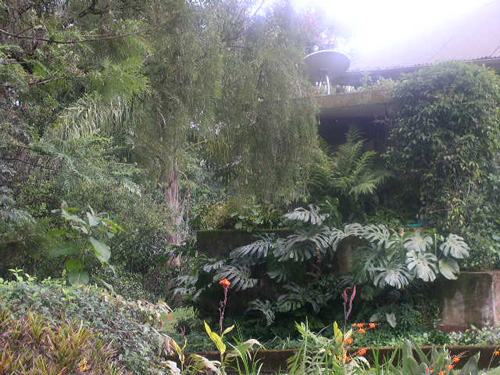
To my great delight, for all my anxiety about living in primitive conditions, unable to eat the food, pee in a latrine (that was still to come) or sleep without fear of huge spiders, mosquitoes and strange animals prowling about, I am in a small cottage with a shower. The cottage is set in lovely garden and the only sound that tells me I’m in Kenya, is the screeching of monkeys that the numerous dogs in the compound chase away.
I came to Kenya to meet the people and see the Rift Valley for myself. I was fascinated by a book I had read titled, The Last Ape Standing, by Chip Walters. In it he explains why and how our human evolution began here, in this vast valley that was once full of trees as far as the eye could see. As climate changed, the landscape became more and more barren causing a scarcity of food harvested from trees and presto! apes stood up and were able to see longer distances, enabling them to evolve into hunters.
I read somewhere else that humans were made for long distance running because of our ability to sweat. We couldn’t out-run other animals, but we could stay cool enough to run until our prey would collapse from heat and exhaustion. The 1988 Olympics in Seoul had Kenyans winning every mens middle and long distance gold medal race except one. Even with seeing that, I’m still amazed to watch them walk and run for miles on end, every day. They walk fast, then slow, then run, then walk again, long, long distances to visit a friend or to haul a jug of water, they walk to work, school, church or mosque, and they do this with very little water to drink.
As for me, I’m happy to have only a few yards to walk to get to the main house where Sr. Freda lives and houses the many missionaries that visit her. But, this is not as easy as it sounds, for at night I must use a flashlight to see my way back to the small cottage. The darkness here is like stepping into a black hole and the meager light from my flashlight barely lights the way. I keep it focused on the ground, hoping it is bright enough to catch a snake that may cross my path. They say to look for the eyes, but all I see are the eyes of the dogs sniffing and following me. They find me boring and after one last sniff, return to the big house. I’m secretly afraid of dogs. I try not to show my fear and wish I was more like my daughter Kelly, who befriends all dogs, big or small. She says she can tell by looking at them if they are menacing or not, but even when I see a dog wag its tail, all it has to do is show its teeth and I whimper and quiver inside. I’m lucky, though, since I’m less afraid of snakes than dogs and wouldn’t mind seeing one during the day. At night, I guess I’m afraid of everything.
The house is quiet but for a Kenyan flag snapping and curling in the wind. It is an old home that I imagine a British official might have owned at one time. It is early morning and I feel self-conscious as I venture out the gated compound and walk along the dirt paths. Groups of children and people hurry to school or to the business area of Kitale, a rather large, sprawling center, where they set up make-shift stands to sell fruits, clothes, key rings, greens and corn. 
There are no paved streets, no sidewalks, nothing but pinkish, sometimes deep red dirt littered with animal droppings as sheep and cows walk casually side by side with the people. Transportation is walking or hopping on the back of a Bodaboda, a bicycle or motorcycle, or riding in one of the 14 seater vans called “Matatus”, where a few extra people are piled in and usually hanging out the doors, the bottom scraping along the bumpy ground. Transportation seems to be a flourishing business for young men to make a living. There is no main industry outside of agriculture in this part of the valley that I can see.
Kids in school uniforms, women carrying water jugs on their heads, people heading to work, all use the same road. I notice the village has satellite stations for cell-phones and I think of how much more Sr. Freda is able to accomplish because she now has the use of a cell phone.
The air is soft and moist yet and I feel the physical actuality of plants, animals, weather and people struggling together as they live their everyday lives. Just about everyone smiles, waves or stops to ask me where I’m from. I stand out and I’m not used to so much attention. I have always enjoyed the anonymity of a large city, but here, I feel like a rock star. The tangled web of streets keeps me from venturing too far. I am anxious, fearing I will get terribly lost. I watch a man carrying a pile of sticks on his back walking up the hill. The altitude here is about 6,000 feet and I am amazed at how people can run and bike up the steep hills.
I walk past an AIDS camp. It’s gated and there are men in uniform walking about. A wooden sign hanging over the entrance reads: US Supported Voluntary Aids Camp. I don’t see signs of people inside the gate, only small huts with tin roofs and the uniformed men. I will soon discover these camps are scattered throughout the area.
As I get closer to the village center, a thin woman, dressed in a faded blouse, baggy skirt, and knitted hat, tiptoes up to me with an unsettling grin. She walks around me as if I’m a prize cow she has just bought. She stands very close. “Are you from the US?” she asks. Her voice is tense, as though she has very little time to talk to me.
“Yeah. I’m visiting Kenya for the first time.”
She pulls a slip of paper from her skirt pocket and thrusts it out to me. “Please give me your e-mail address and I will write to you.”
At first, I’m too surprised to answer. She presses on. “I can show you around the village.” I smile and begin to walk on, saying I will come back another time. She follows me, offering to be my friend. I know she is hustling me, but at the same time, I don’t care. I want to help her, but I had walked out of the compound without anything, not a purse, money, not even lipstick, which I usually have on hand at all times. I’m embarrassed. I haven’t a thing to give her. I can only smile and walk along, trying to remember my way back. After a while, she gives up and looks around for someone more promising.
On my way back, children run alongside me, shrieking with excitement. I shake their hands and they run off, laughing. I look a bit lost. They find me funny and for a minute, so do I. I ask for directions to Sr. Freda’s from an old man who is sitting in front of a shop built from scrapes of metal and cardboard boxes. He has a long, thin neck and lowers his eyes, but nods his bald head reassuringly in the direction I’m walking.
It takes me fifteen minutes to cross a four corner intersection, for it has no stop signs and the fast moving motorbikes and Manitus’ seem not to care about pedestrians. People wait patiently for an opening. Every now and then I’d hear someone hiss, “let’s go,” and a brave few souls would dash out and make it to the other side. It is a lot like trying to hop into a turning jump rope without getting hit. You have to time it just right. I finally get my chance. The whole world seems to stand still as I run. I don’t hear anything except for the air I heave into my lungs, hoping I won’t be hit. I will my heart to slow and begin walking and am soon rewarded by seeing the gated Aids camp. I have only to walk another mile up the curving road and I’ll be home. And home it is.
The moment I met Sr. Freda, (she is not a Catholic nun but, in Kenya she is called Sister as a sign of respect) I felt I was the most important person in the world and as she took my hand in greeting and gave me a hug she whispered, “We were fated by God to meet.” I think I will choose to believe her.

 Betty In Kenya
Nikki
/ March 25, 2014Sister, I feel as if I were walking with you, and as scared!
Betty LaSorella
/ March 27, 2014Oh, I like that.
Julie and paul
/ March 25, 2014It is so wonderful to be able up share in your journey.
Betty LaSorella
/ March 27, 2014Thanks you two – it’s wonderful to have you along.
Jill
/ March 26, 2014I like the balance between your internal monologue and what you see around you. Inspired last line!
Betty LaSorella
/ March 27, 2014As always, you help me keep going.
fentrasakong
/ March 26, 2014Welcome to my home town (Kitale). It now looks like you are liking this country. Be blessed
Betty LaSorella
/ March 27, 2014I love, love your country. Is is beautiful and the people are wise and caring.
jim
/ March 26, 2014Keep writing the story. Don’t stop! Fascinating!
Betty LaSorella
/ March 27, 2014Thanks for your encouragement. I need it.
polly mann
/ March 28, 2014I am already enjoying your notes. How wonderful – thanks, Betty.
Polly M
Betty LaSorella
/ March 29, 2014I’m so glad and happy by your interest and kind words.